
CAPSTONE · MASTER OF UX DESIGN · 2026
HAVEN
Housing Adaptation & Valuation Equity Navigator
Leave on your terms — not the market’s.
ROLE
Solo UX Designer · Researcher
TIMELINE
Jan – May 2026 · 16 weeks
PROGRAM
MICA · MA UX Design Capstone
TOOLS
Figma · FigJam · Typeform · Otter
PROCESS · 16 WEEKS · 4 PHASES
Sixteen weeks, four phases.
Research produced the features; features created the flow; flow connected with users; users altered the design.
01
WEEKS 1–4
DISCOVERY
Listen first.
Secondary research (a competitive review of ten organizations), a recruiter screener, and six customer Discovery interviews in five different states.
Eighty-plus findings. Nine affinity groups.
02
WEEKS 5–7
DEFINE
Look for patterns.
Two composites. Four journey maps: current and future state per composite. One MVP feature set developed from the groupings of the Discovery interviews.
2 personas · 4 journeys · 4 features
03
WEEKS 8–12
DESIGN
Create the structure, then the skin.
Lo-fi wireframes of all four flows in Figma at iPhone width. Developed a component library, Design tokens, and Lo-fi versions of each flow with auto-layout starting at screen one.
4 flows · 25+ screens · component library
04
WEEKS 13–16
TEST & REFINE
Allow users to test 4 flows.
I ran wireframe usability tests with five participants. Sixty-four observations clustered into eight themes. Three structural changes carried into hi-fi: slider header pinned, dashboard reordered, Truth-Meter weighted breakdown.
5 tests · 64 observations · 3 redesigns
THE CHALLENGE
Insurers are withdrawing from climate-risk areas. Premiums in certain California zip codes have almost doubled over the past 5 years. First Street estimates that flood and fire risk will remove trillions from the U.S. property market by 2055. Yet there isn't a single way for consumers to calculate the cost of their home's risk or determine what it would take to relocate. Data exists, but translation doesn't.
$1.6T
Projected U.S. property value loss to climate risk by 2055
(First Street, 2024)
2×
Insurance premium increases in high-risk CA/FL zip codes since 2020
(III, 2024)
0
Consumer tools that connect climate risk to equity outcomes
(Competitive analysis, 10 competitors)
“We've never considered moving because of family.
Family is the main concern about relocating.”
DAVE · OXNARD, CA · HOMEOWNER SINCE 2004
WHY THIS EXISTS
I lived next door to this
problem for a decade.
I have been designing for the FinTech industry for 10 years. Insurers left California and Florida, but my friends and family bought houses in those zip codes. There has never been a product to help them decide whether to stay or relocate after their home purchase. This is exactly what HAVEN is intended to do: a mobile planning tool that converts climate risk into a financial decision-making process. HAVEN is both my Master’s Thesis and my exploration of GreenTech.
WHERE THE GAP WAS
No one connected the dots.
COMPETITIVE ANALYSIS · 10 COMPETITORS · NN/G HEURISTIC
Five direct competitors. Five indirect. One gap.
I reviewed ten organizations based on their value propositions, degree of customization, tone, and design implications. Direct competitors include: First Street Foundation, Redfin, ClimateCheck, Zillow, and Kin Insurance. Indirect competitors include: Nextdoor, Policygenius, state mitigation programs, human CFPs, and Climate Risk Media.
CORE GAP
No existing competitor connects climate risk data → projected equity loss → stay-vs-move scenarios → relocation savings. That's the gap HAVEN fills.
WHO IT'S FOR
I needed to talk to people living through this, not just read about it. A 9-question Typeform screener, distributed through my professional network, filtered for housing situation, climate exposure, and willingness to think aloud. Six participants, five states. Many had spent twenty-plus years building wealth in their homes. One had recently moved from Miami. Two composite personas emerged at the extremes of the same spectrum: rooted and mobile.
6
Customer-discovery interviews
(NN/g semi-structured)
5
U.S. states represented
(CA, FL, WA, MI, CO)
80+
Verbatim findings
clustered into 9 themes
PRIMARY PERSONA · PROTAGONIST OF THIS CASE STUDY
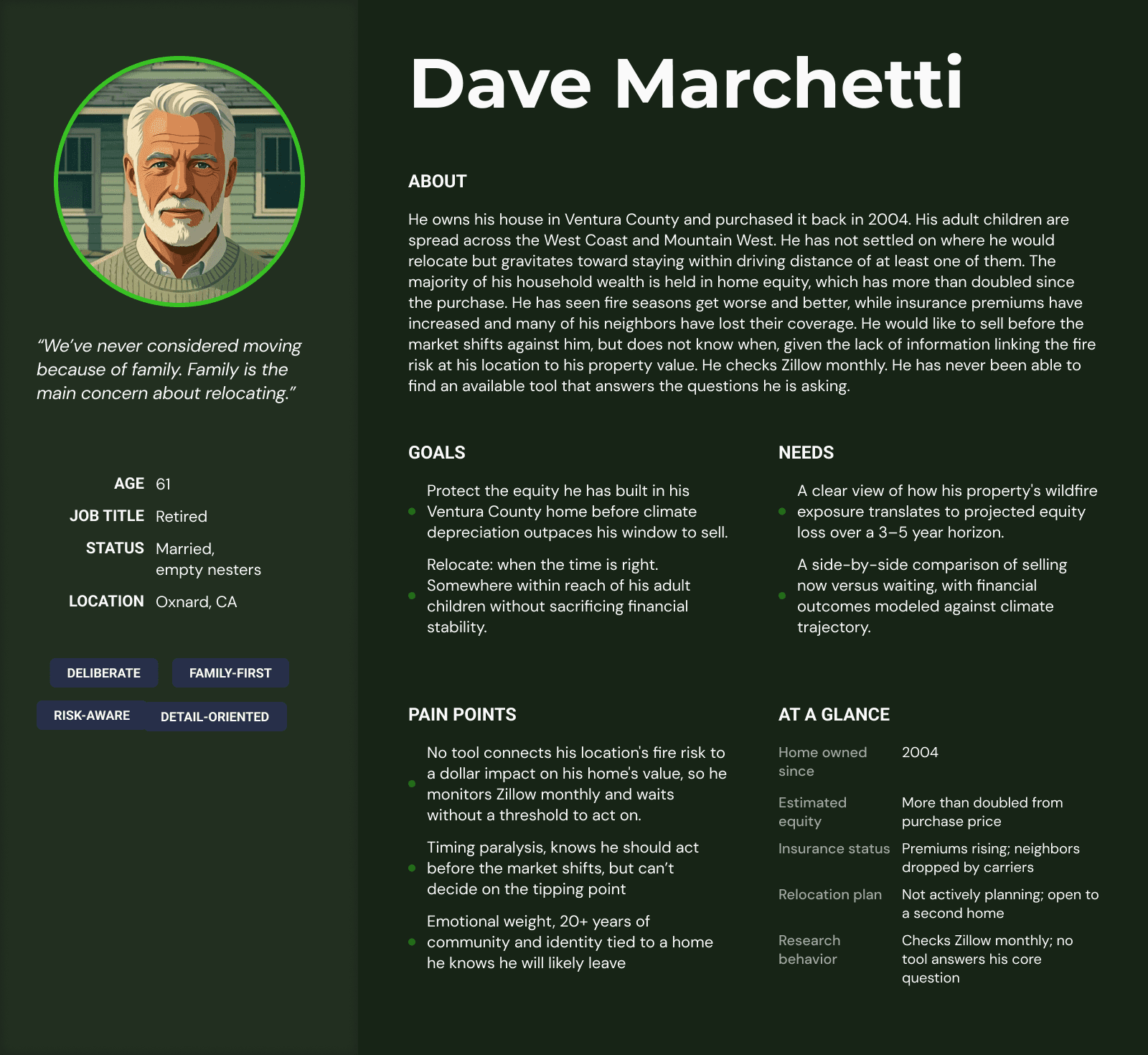
EQUITY PROTECTOR · ROOTED
Dave Marchetti
58 · Ventura County, CA · Homeowner since 2004 · Two grown kids, ten miles away
“We've never considered moving because of family. Family is the main concern about relocating.”
GOALS
Protect equity built over 20 years. Stay near family. Make a defensible decision before insurance forces one.
PAINS
Premiums climbing 20% a year. No tool translates risk into dollars. Adult kids assume he'll never leave.
SECONDARY PERSONA · CLIMATE-CONSCIOUS STARTER · MOBILE
Natalie Torres — 29 · Miami → Dallas · First-time buyer balancing climate exit with financial start.
→
→
View full persona
WHAT HOMEOWNERS TOLD ME
All quotes from the six interviews went into a FigJam affinity map and the themes emerged organically. Nine clusters surfaced. The three below are the ones that shaped HAVEN's MVP, the rest informed tone, microcopy, and how I cite sources.
AFFINITY MAP · FIGJAM · 9 CLUSTERS · 80+ STICKIES · CLICK TO PAN/ZOOM
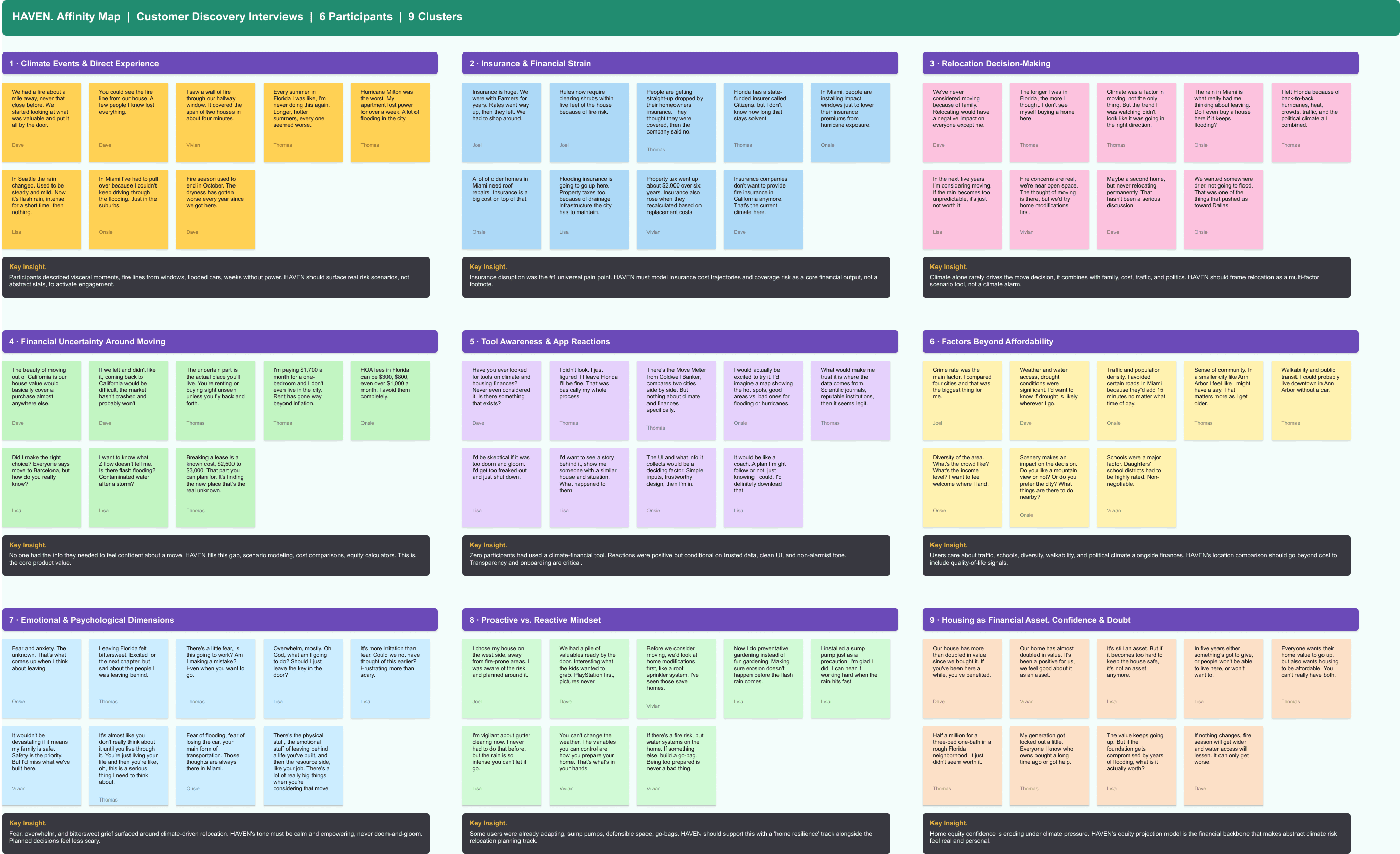
CLUSTER 02
Insurance is the wake-up call
Every participant named insurance costs as their first climate-financial concern, unprompted. Insurance became the entry point for every onboarding conversation.
→ Onboarding Coach
CLUSTER 01
Climate events drive engagement
Personal stories about a fire, a flood, a renewal letter, those moved decisions. Abstract risk percentages did not.
→ Personal narrative throughout
CLUSTER 04
Financial uncertainty around moving
Even rooted homeowners ran the numbers in their heads. They wanted a way to compare staying vs leaving without committing to either.
→ Alternative Reality Slider
IDEATION · CLUSTER → FEATURE MAPPING
Nine clusters came from the affinity map. I mapped each against two questions. How often does it appear among multiple individuals? Can a mobile feature be applied within the MVP scope to address it?
Of the nine clusters, the top-right four served as the basis for HAVEN’s features. The remaining five pertained to the tone, copy, and data references cited by the application.
PRIORITIZATION MATRIX
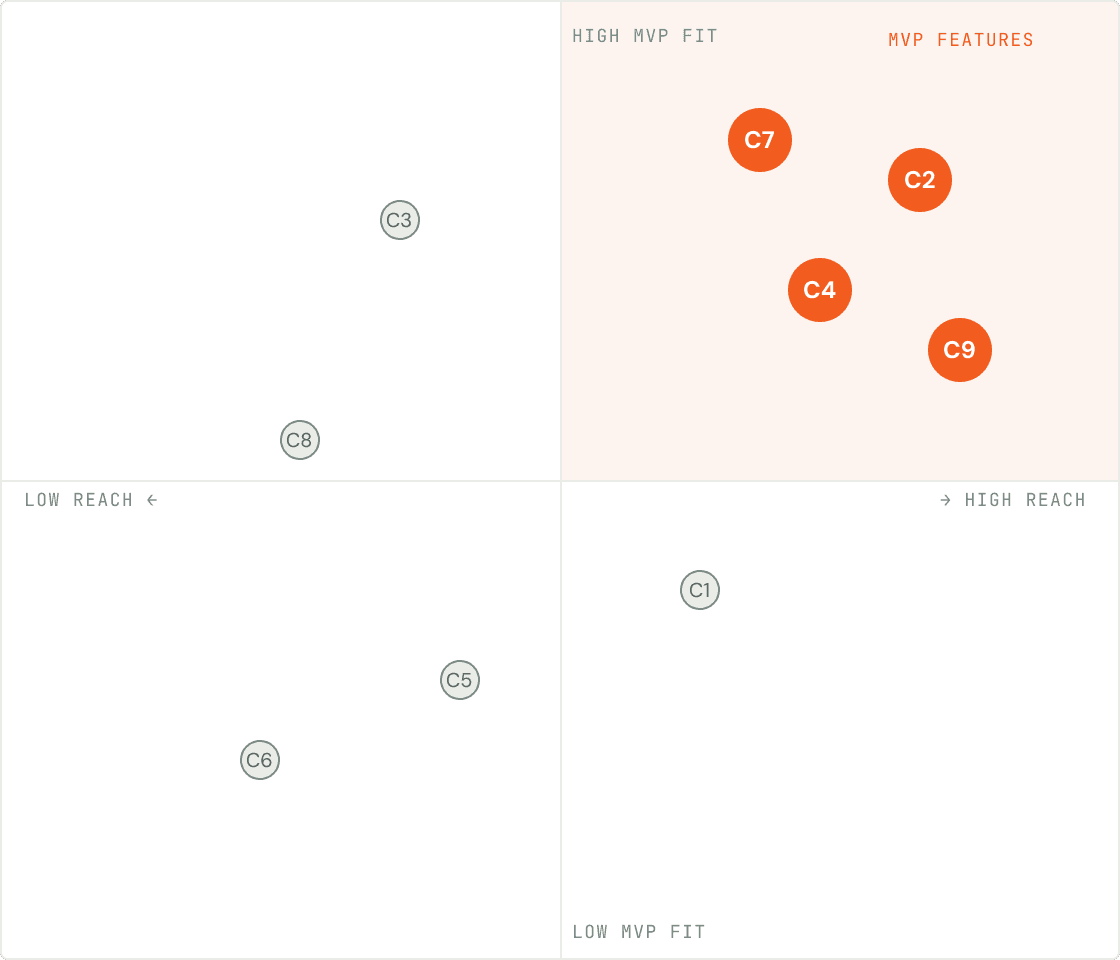
Each dot represents a cluster from the affinity map. Orange dots represent clusters used to create MVP features. Smaller red dots informed tone, microcopy, and data citations.
CLUSTER → MVP FEATURE
Cluster 2 · Insurance as wake-up call
Onboarding Coach
A short discussion that changes an insurance wake-up call into a personal risk and equity profile.
Cluster 7 · Emotional and psychological dimensions
Silent Questions Anchor Quiz
Silent questions that identify decision-making style. The decision style categories are: Equity Protector, Reluctant Mover, or Undecided.
Cluster 4 · Uncertainty regarding finance when moving
Alternative Reality Slider
A timeline showing how staying versus moving will affect equity and insurance costs from year 1 through year 10.
Cluster 9 · Trust requires citation
Transparency Truth Meter
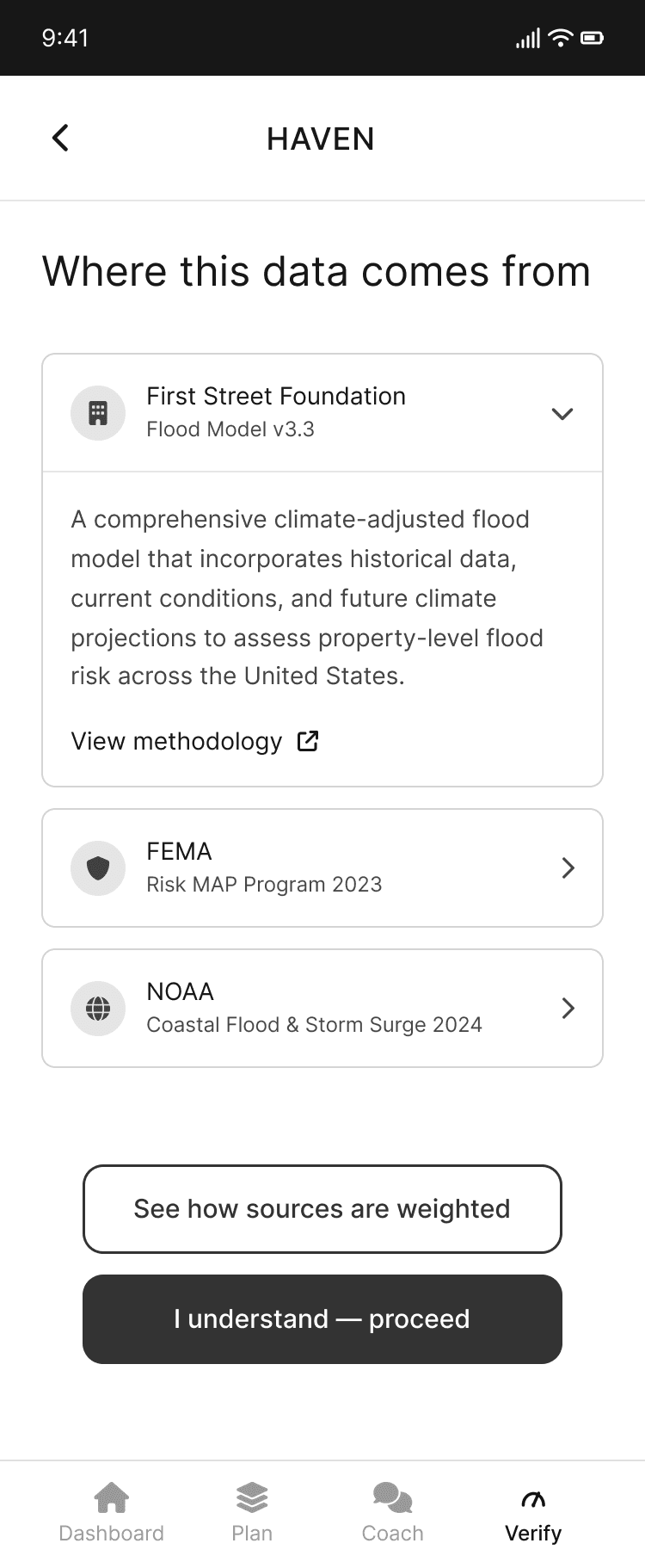
All scores are referenced (First Street, NOAA, FEMA), along with the confidence level weights for each.
THE FRAMEWORK
Climate adaptation is a financial right, not a privilege. That belief influenced each feature development decision. HAVEN translates climate risk into a financial conversation a homeowner can act on, using four distinct features. Each feature relates directly to a cluster from the interviews.
01
COACH
Onboarding Chat
A chat that builds the user's climate-financial profile in less than 3 minutes.
02
EMOTIONAL
Anchor Quiz
Four questions identify your decision style and tailor recommendations based on your answers.
03
ALTERNATIVE
Reality Slider
Drag a timeline to view how remaining versus relocating affects your equity over a period of time ranging from 1 year to 10 years.
04
TRUTH-METER
Transparency Layer
Every score indicates which data source(s) contributed to it, along with a confidence rating.
CONCEPT EVOLUTION · 3 DIRECTIONS CONSIDERED
Before arriving at the coach, quiz, slider, and transparency layer, I tried three other directions. All three failed for the same reason. Below: each direction, why I tried it, and what survived in the final concept.
REJECTED
Risk-score app
A single climate risk score, like a credit score.
I attempted it because I first tried to translate Street and NOAA data into a simple 0–100 climate-risk score for any given address. Simple and marketable.
WHY IT FAILED
Every participant stated the same thing when asked whether they trusted the scores, without citing sources. Scores killed conversations. The score directed participants to believe what to think. Participants wanted evidence presented in conversations.
WHAT SURVIVED
The Truth-Meter feature. Rather than concealing the math behind the score, all scores in HAVEN name their references and apply confidence-based weightings.
REJECTED
Relocation tool first
A relocation recommender for climate refugees.
I attempted it because relocating to a new city due to climate change seemed like a logical target audience. Recommend destination cities based on their climate resilience and cost of living.
WHY IT FAILED
One of the six was considering relocating. The other five had strong ties — family proximity, community — that outweighed climate-based factors in their stay-vs-leave thinking. A relocation recommender would have served 1 in 6.
WHAT SURVIVED
The Alternative Reality Slider. Rather than directly suggesting where users should move based upon climate risk, this allows users to compare staying at home versus moving on their own terms.
REJECTED
Premium tracker
An insurance-premium forecaster tied to a zip code.
Insurance was the most common theme among interview participants. Many unprompted discussions were related to insurance. Creating a premium predictor seemed the best path forward.
WHY IT FAILED
Premiums were the alarm that got people’s attention but were not part of the decision process after that. The application needed to discuss more than just premiums to help them make a decision.
WHAT SURVIVED
The Onboarding Coach uses insurance as the starting point, then expands to risk, equity, and timeline.
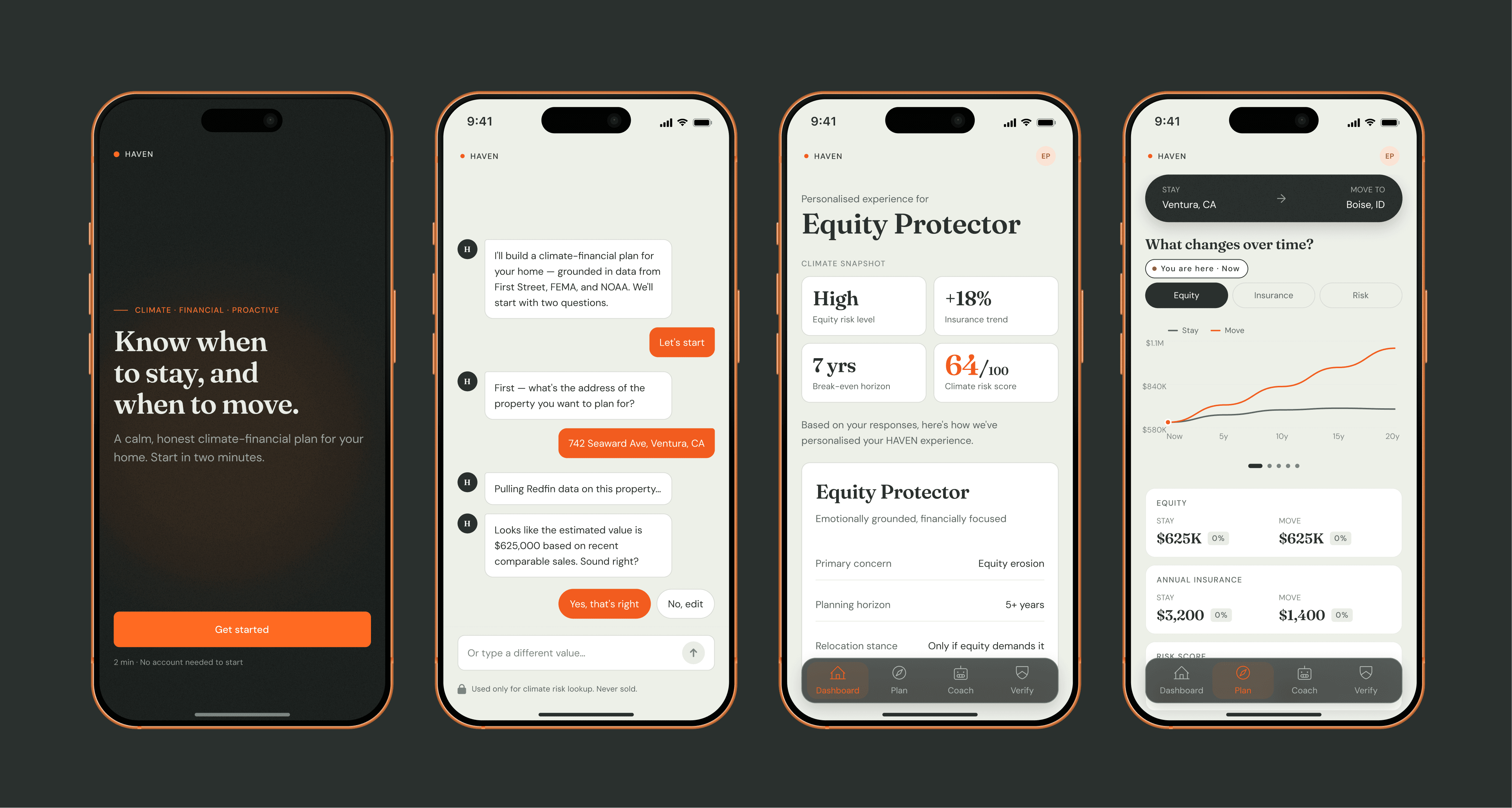
WHAT IT LOOKS LIKE · WIREFRAMES
Four flows. One sheet.
Each MVP feature became a flow of three to seven screens, all wireframed in Figma at iPhone width. Auto-layout from the first sketch, so the structure carried into hi-fi unchanged. Below: one screen from each flow, the moment where the flow pays off. The other 24 live behind the link.
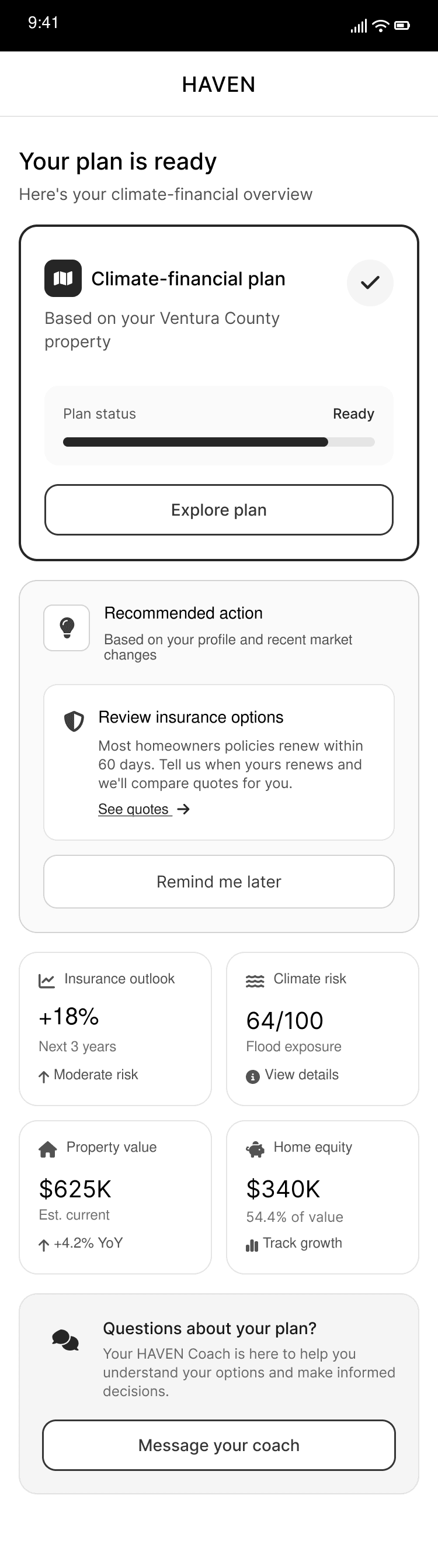
Flow 01
·
7
SCREENS
Onboarding Coach
S1.06 · Dashboard, post-onboarding
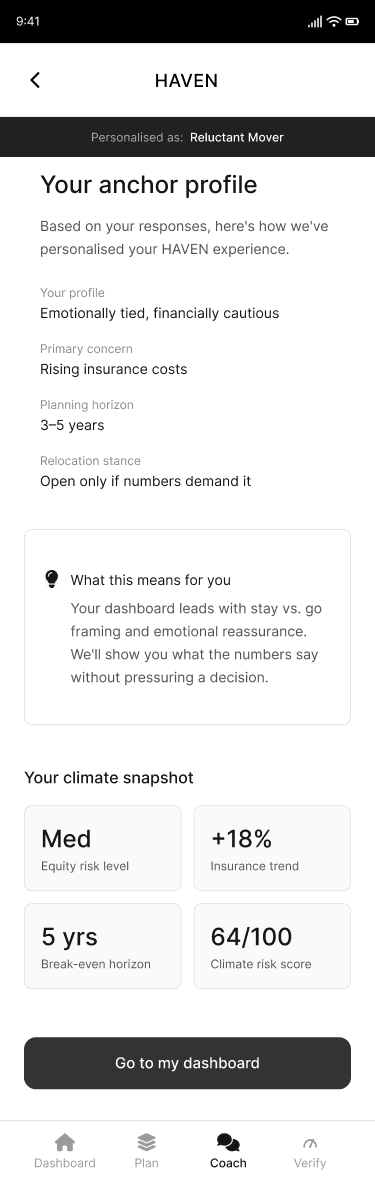
Flow 02
·
10
SCREENS
Emotional Anchor Quiz
S2.08a • Result: Equity Protector
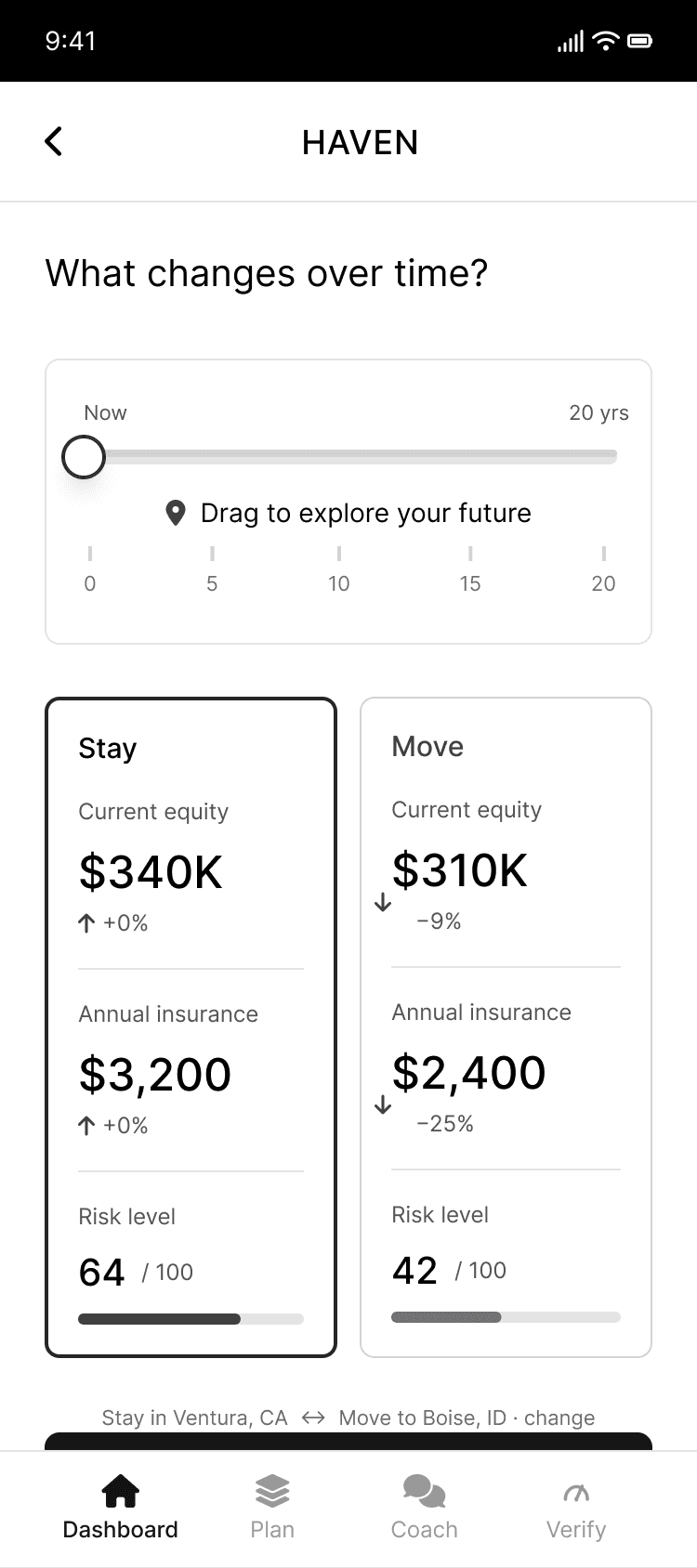
Flow 03
·
6
SCREENS
Alternative Reality Slider
S3.02 • Slider • 5-year view
Flow 04
·
5
SCREENS
Truth-Meter
$4.02 • Where the data comes from
WHAT IT LOOKS LIKE · HI-FI
Calm under pressure.
The system carries weight without raising voice. Sage greens make the climate work readable. Burnt orange is reserved for the moments where someone has to decide. Fraunces sets the headlines and the numbers. DM Sans does everything else.
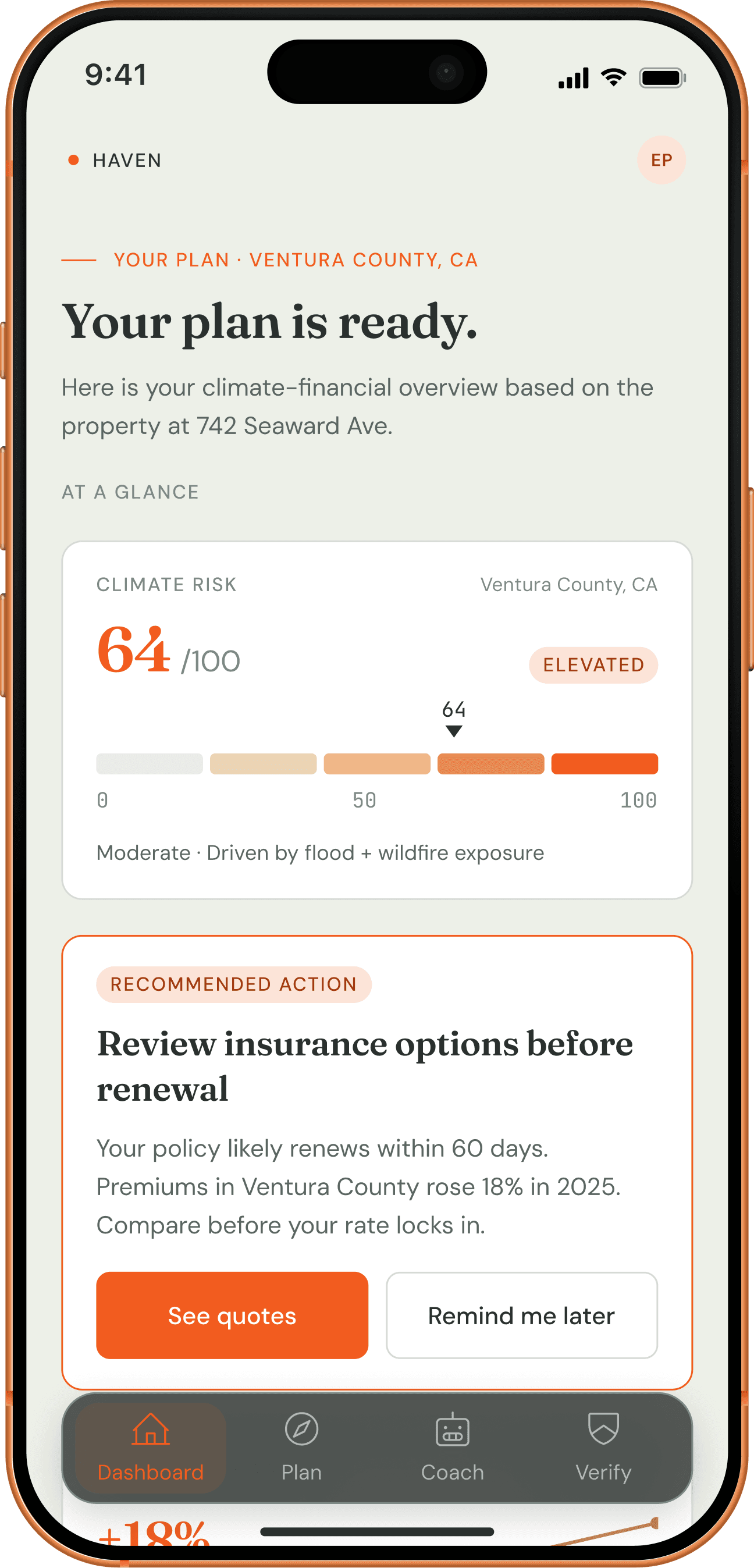
FLOW
01
·
DASHBOARD
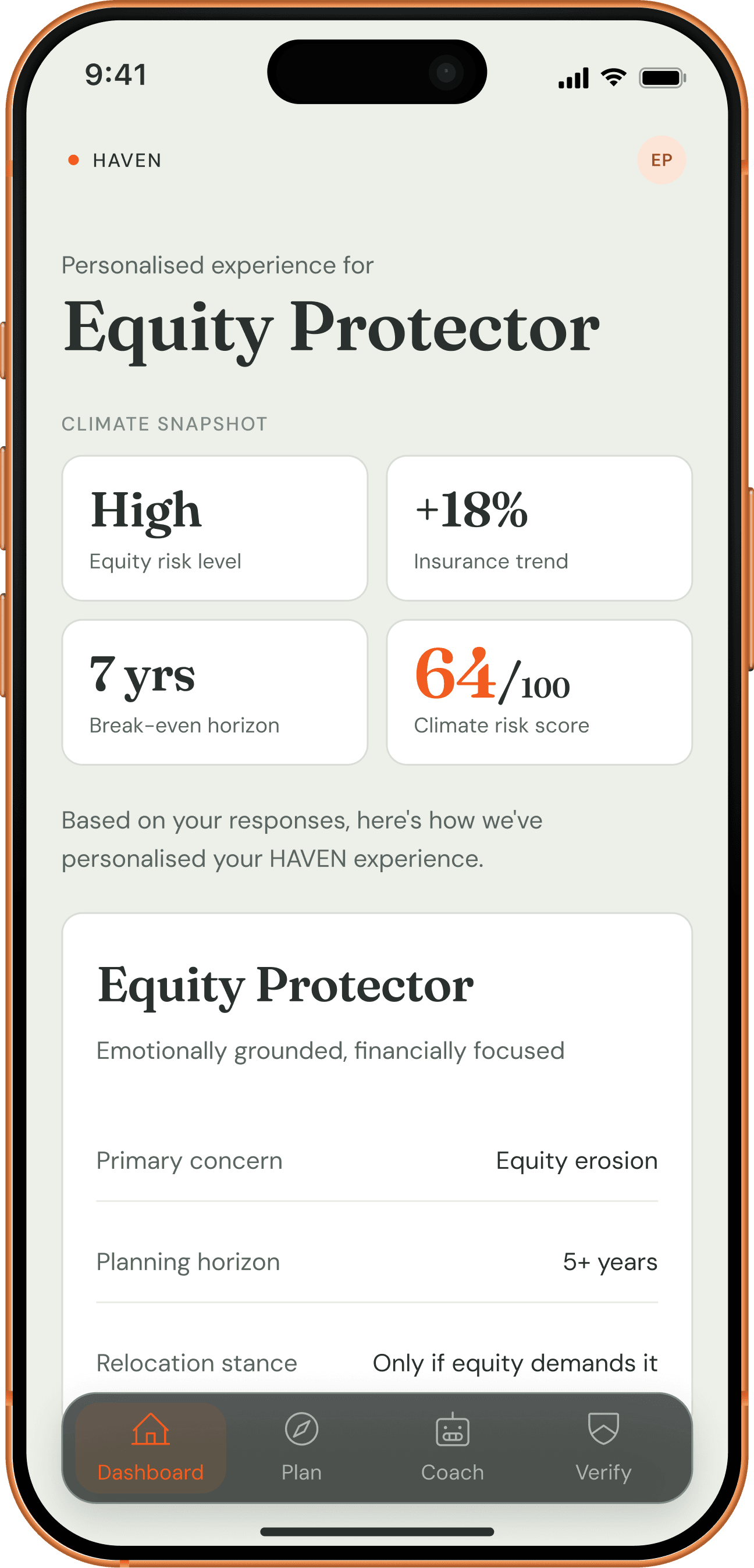
FLOW
02
·
EQUITY PROTECTOR
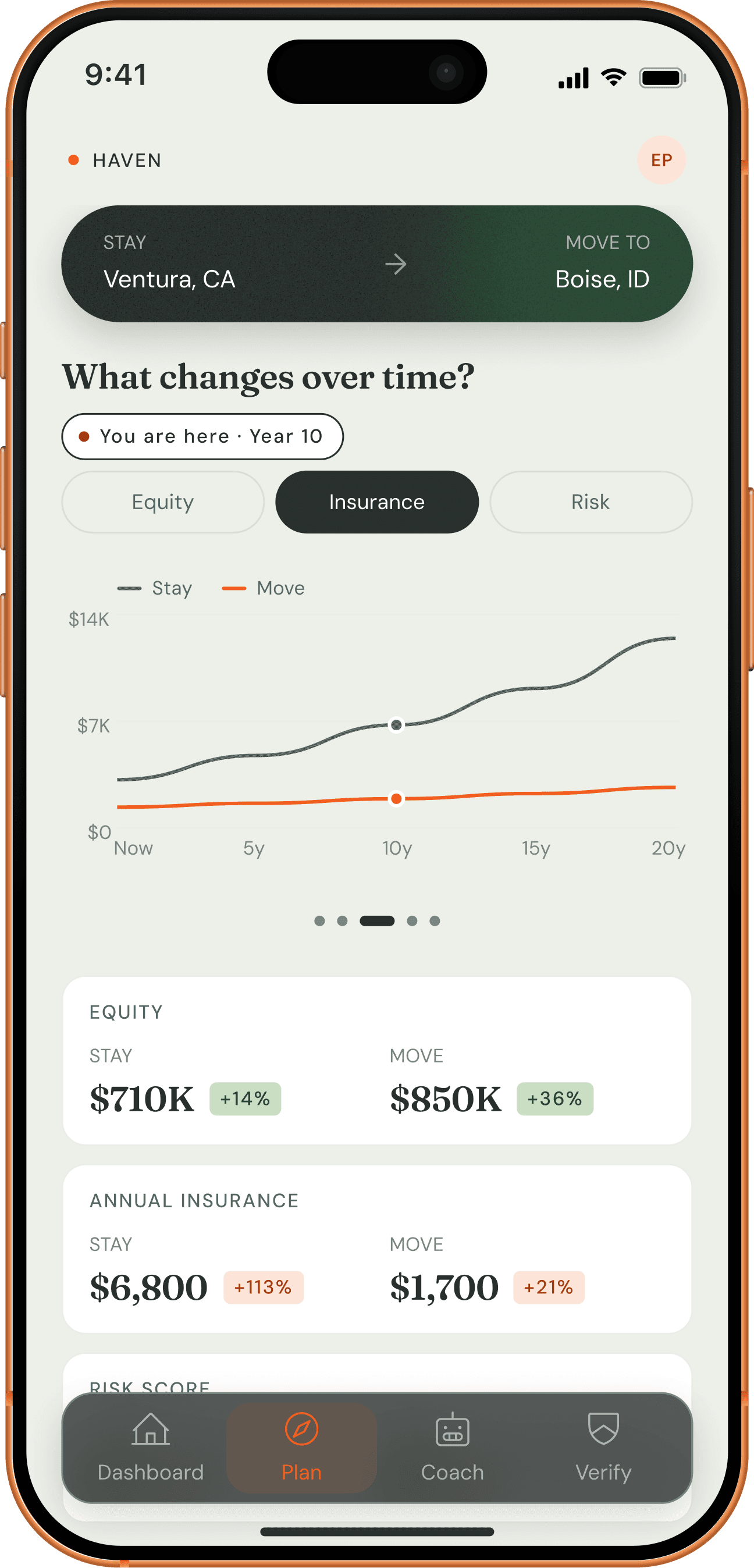
FLOW
03
·
REALITY SLIDER
FLOW
04
·
TRUTH -METER
ITERATION · POST-TESTING · BEFORE & AFTER
Three changes the testing forced.
Five participants tested the wireframes. The 64 observations were clustered into eight themes.
Three of those themes, destination, hierarchy, and trust, forced structural changes between lo-fi and hi-fi. Here are the three.
5
Wireframe usability sessions
64
Verbatim observations
8
Themes identified
3
Structural redesigns
01 · SLIDER
Where am I moving to?
BEFORE
AFTER
WHAT TESTING SURFACED
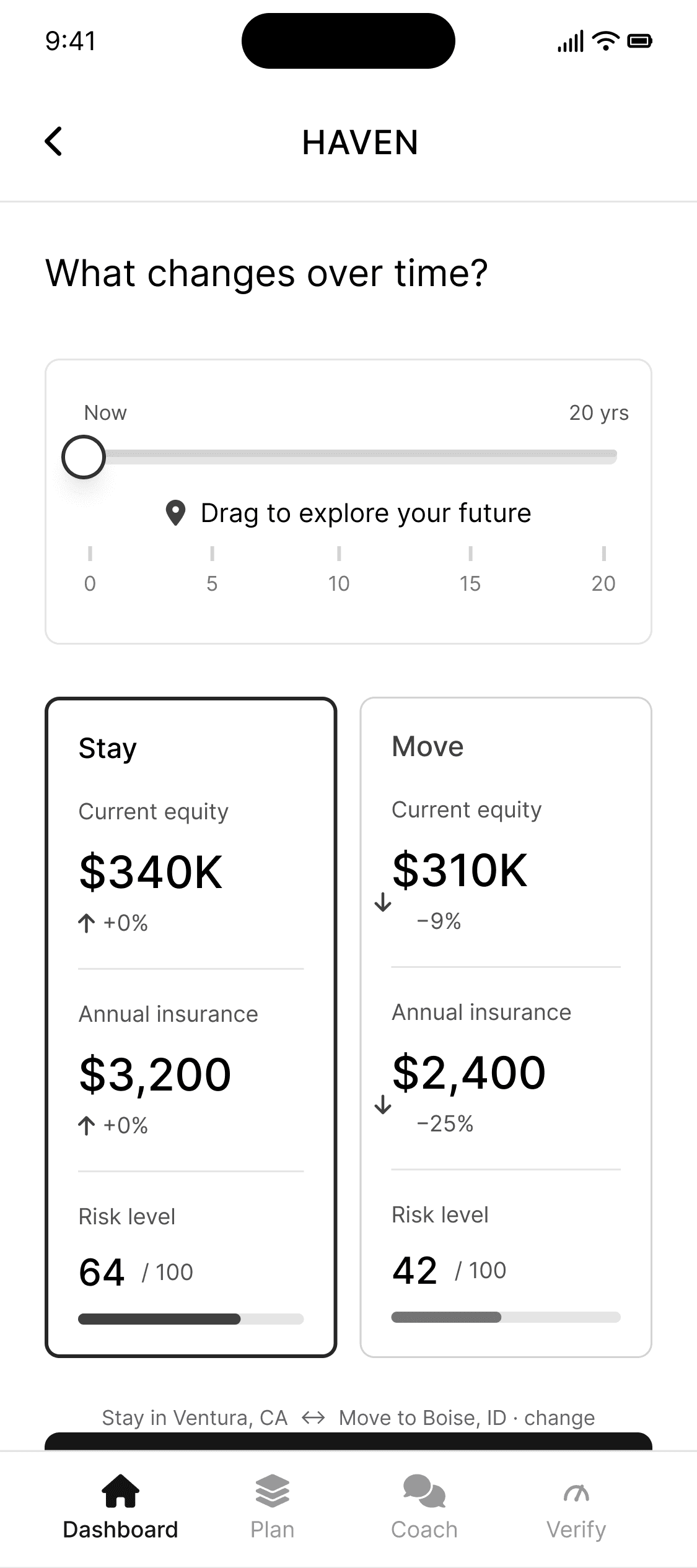
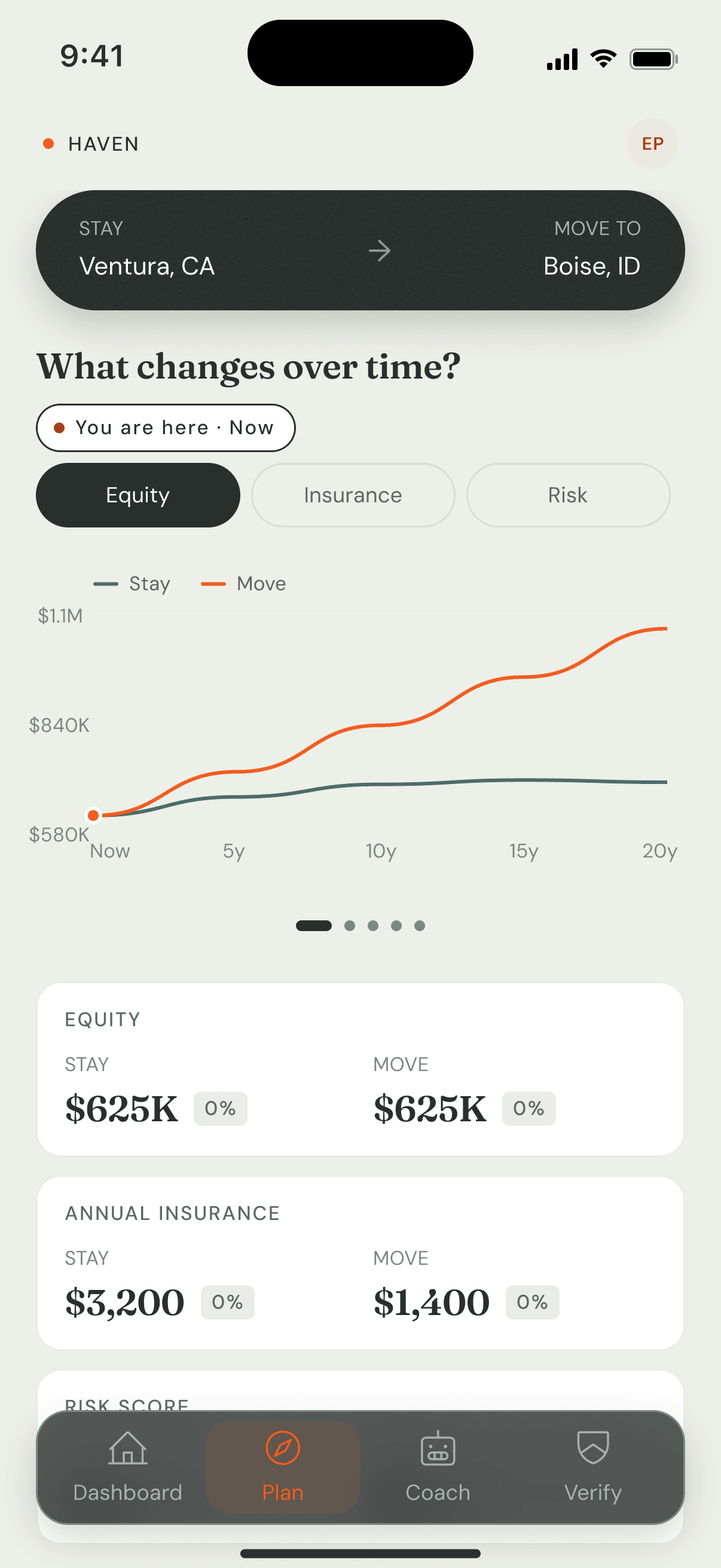
Two participants asked the same question, unprompted, the moment they saw the slider. The destination labels sat at the bottom of the screen in small meta text. The first thing the design needed to answer was the first thing it hid.
“Where am I moving to? You moved me, but where? I would have put it up here, because that’s the first thing I thought.”
Vivian · Jefferson County CO homeowner · Wireframe test, 04/25
“How does it know where I’m moving to? It might be helpful if I saw up here what this was comparing.” — Thomas, Tampa renter
WHAT CHANGED
Destination moved from meta text to a dark forest header pinned to the top of the screen: “STAY · Ventura, CA → MOVE TO · Boise, ID.” It’s the first thing you see. The slider works because of it.
02 · DASHBOARD
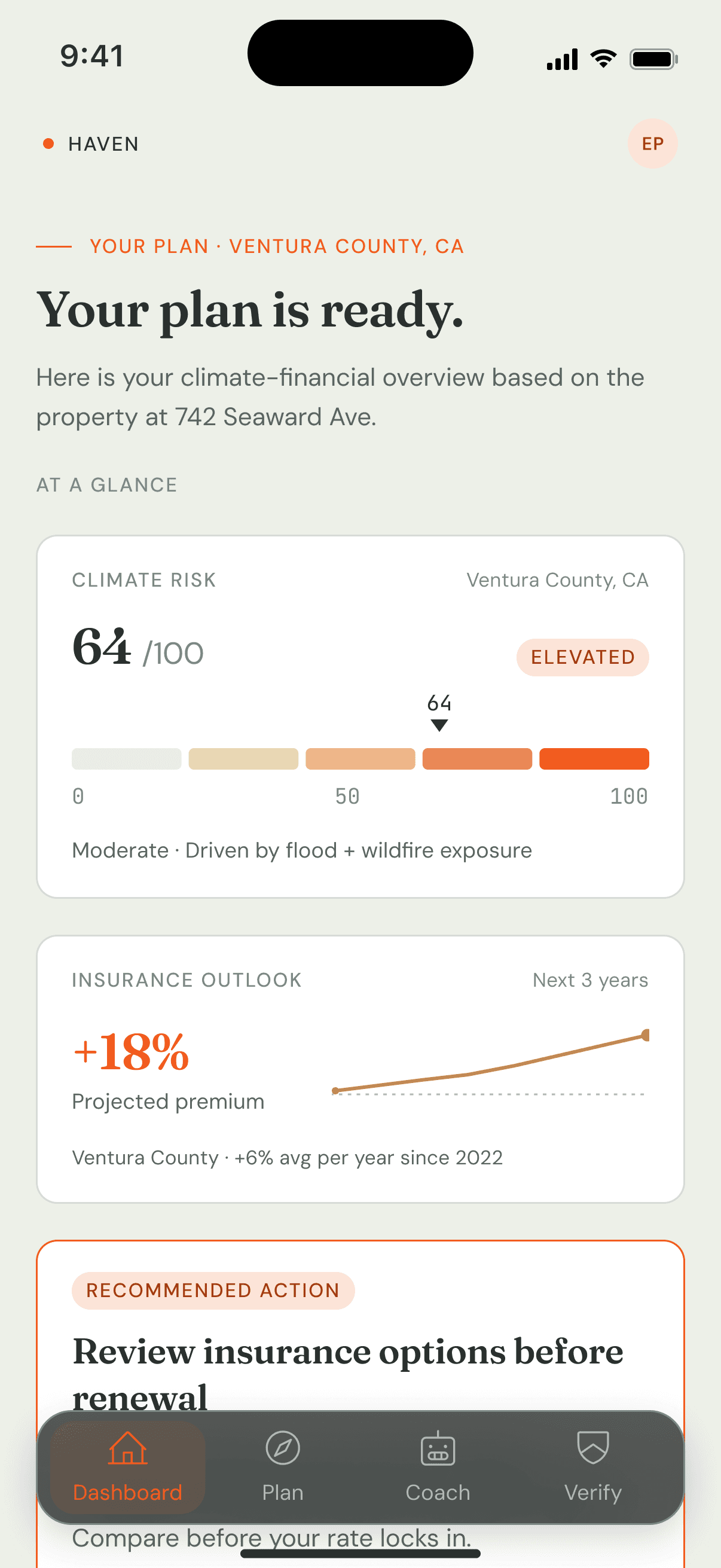
Show me the next thing to do.
BEFORE
AFTER
WHAT TESTING SURFACED
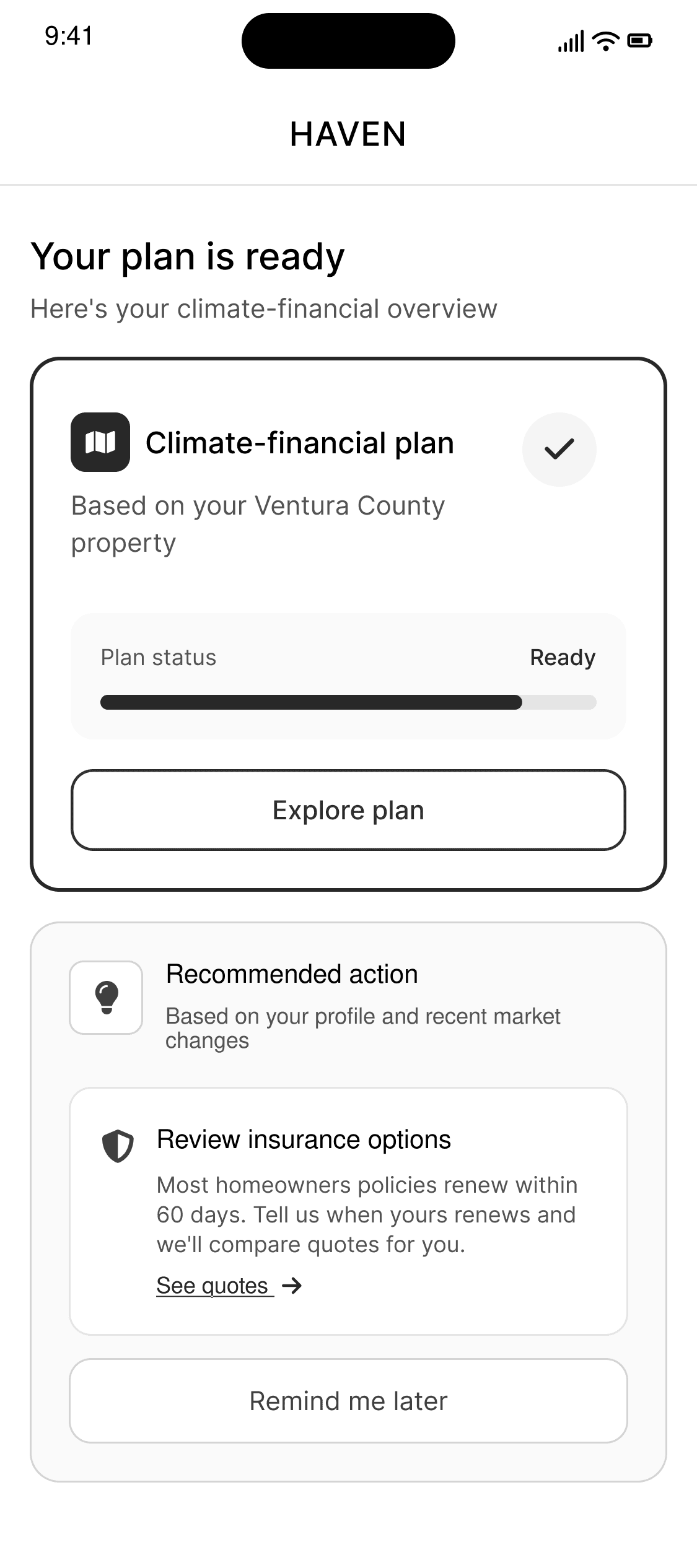
Lo-fi presented every metric with equal weight in a 2×2 grid. Three participants said the dashboard should tell them what to do next, not ask them to figure it out.
“Could one be highlighted in some way — if it’s first or different color — just something where you’re feeding them their top cared-about piece based on the information they gave.”
Kyle · Wireframe test, 04/24
“I was expecting like numbers like this. So this is good.” — Thomas (after seeing the hi-fi)
WHAT CHANGED
Recommended Action moved to the top. The climate-risk gauge takes the most space. The stay-vs-move CTA sits inside a dark forest panel at the bottom of the screen — the next decision the user has to make.
03 · TRUTH-METER
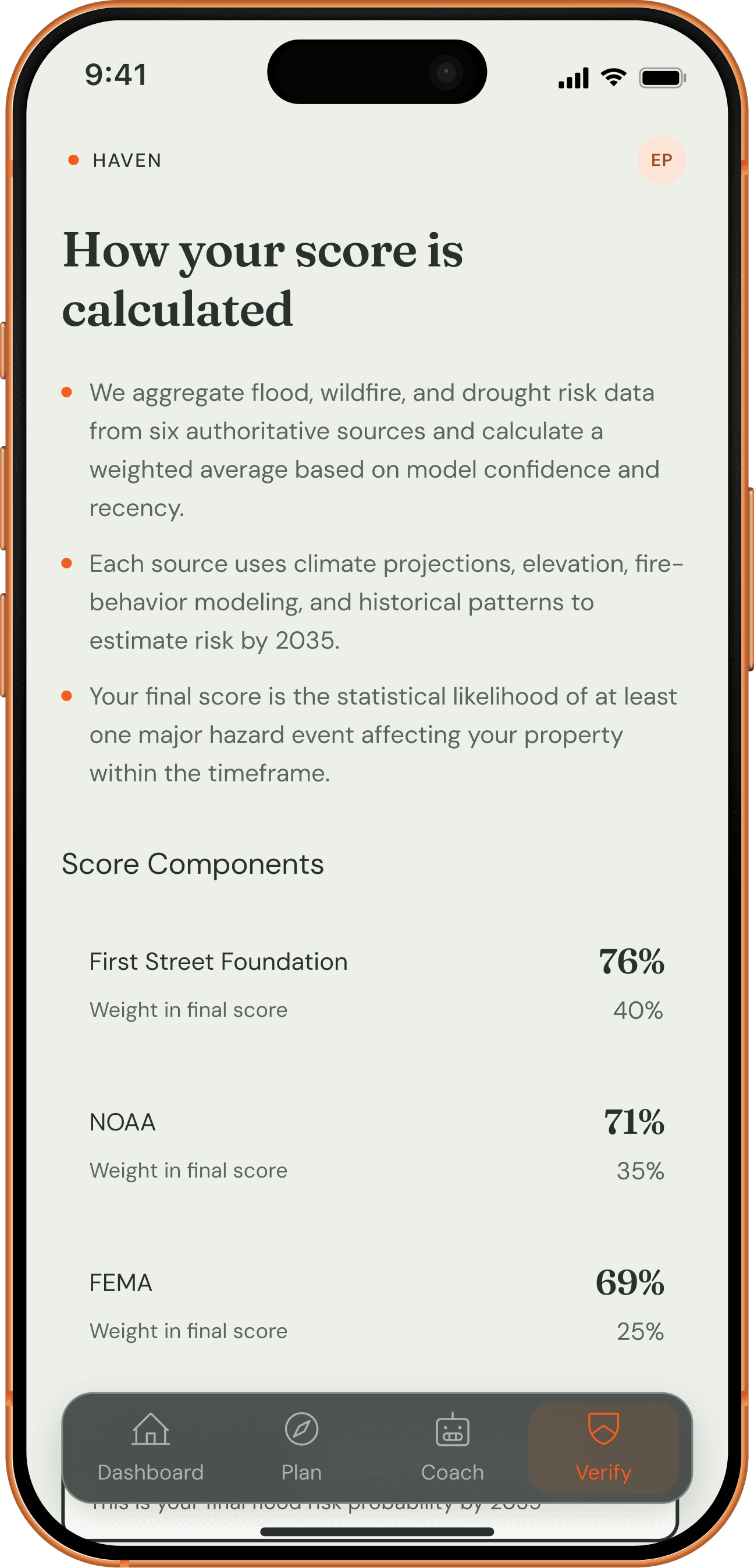
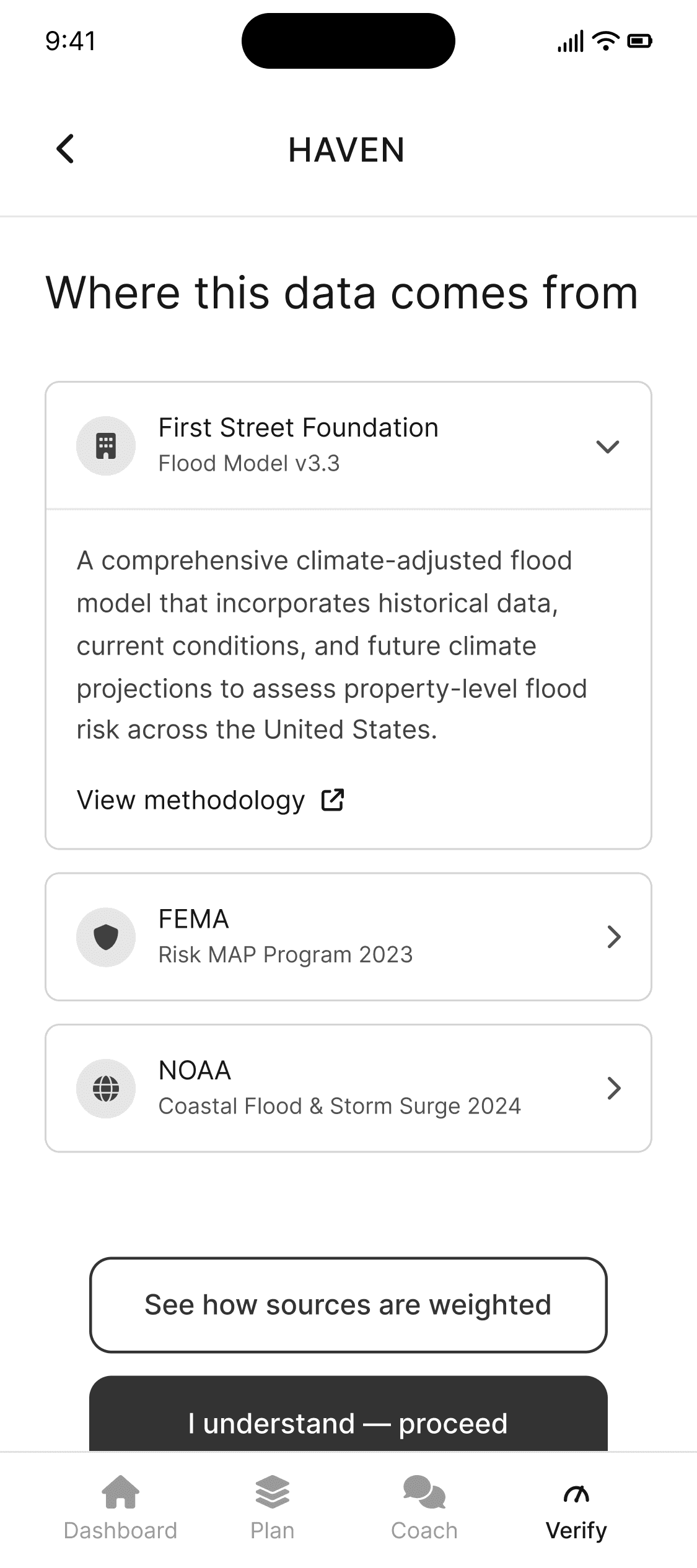
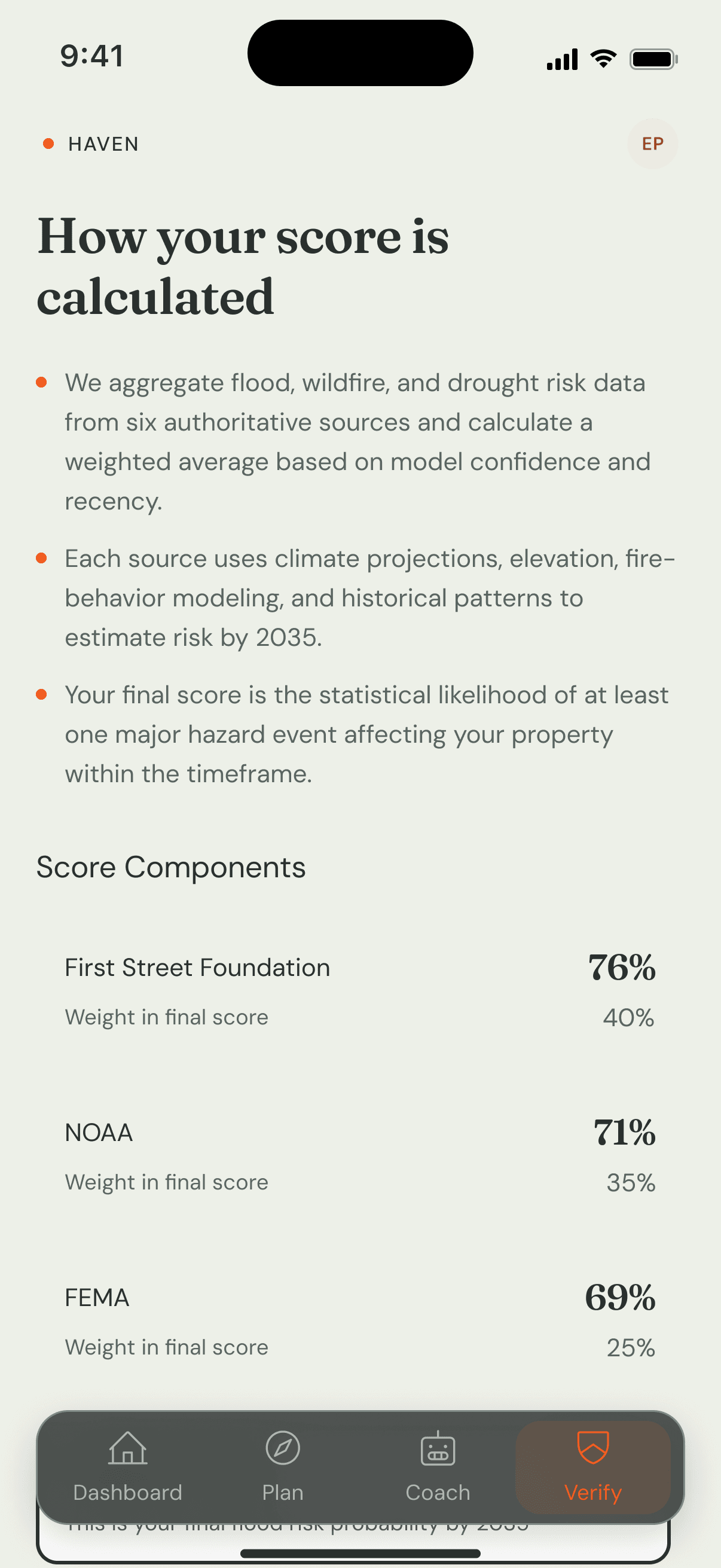
Show me the math, not just the sources.
BEFORE
WHAT TESTING SURFACED
Every participant recognized FEMA. Most didn’t recognize First Street Foundation. They wanted to know what each source actually contributed to the final number, not just that the sources existed.
“It’s cool that you can see how the sources are weighted. First Street Foundation is the heaviest one, which is interesting because that’s the one I don’t know.”
Thomas · Wireframe test, 04/28
“How is it calculated? I’m guessing the information is coming from First Street, NOAA, and FEMA.” — Vivian
WHAT CHANGED
The source-list cards became a weighted breakdown: confidence per source, weight in the final score, and a featured card showing the weighted average. The math is on the page now, not behind “View methodology.”
CHALLENGES · WHAT MADE THIS HARD
The four challenges that almost derailed this project.
Capstones are constrained by four factors: time, budget, skills, and scope. Here's how each one shaped the work.
01
SCOPE
Going from vision to MVP without losing thesis.
The initial concept included six features. Calculators, a recommendation engine for destinations, a community layer, a financial coach, an insurance tracking system, and a layer of transparency. Those sixteen weeks could not support that level of complexity, so I rebuilt the scope around the four clusters which appeared in every study conducted during the Discovery phase and put the rest into backlog. The thesis remained intact because the cuts came from research, not taste.
TRADE-OFF · Went from 6 features to 4. Documented backlog.
02
TONE
The default tone in climate change is alarm. Every user wanted something not-so-urgent, not doom and gloom.
My first wireframes included red urgent copy and language that framed risks in a way that was conventional in climate tools. However, every research participant said the same thing about my work. Doom kills conversations. Therefore, I changed the visual system to use sage colors and rationed usage of orange. Rewrote every line of microcopy using plain language that encouraged calmness and reserved alarm calls for moments when decisions were actually required.
DECISION · Calmness is a choice in design, not a default.
03
SOLO
No team members were available to brainstorm ideas with or to develop ideas behind the scenes.
STRATEGY · Replaced a teammate with a usability round.
04
TIME
A full-time job, two kids, and a thesis on the same sixteen weeks.
In addition to working a full-time job, raising a family, and designing my capstone project during the same sixteen weeks, there was no way to separate them. Most of the design work took place at night or on weekends. As a perfectionist by nature, I could not schedule this. Therefore, I had to develop the discipline to block out large portions of my day (two to four hours) to work on my design, to clearly define what I needed to accomplish before leaving my workstation, and ultimately to be willing to “ship” something good enough, rather than spending all of the time necessary to polish every detail that reviewers would never actually look at.
PRACTICE · Ship good enough. Polish what reviewers will see.
WHAT I’M TAKING WITH ME
OUTCOME
A working hi-fi prototype, ready to test and refine.
At this juncture, HAVEN encompasses four high-fidelity MVP flows, a full component library, two composite personas, four journey maps, and a research report founded on six discovery interviews and five usability testing sessions. Sufficient infrastructure currently exists to support continued development post-capstone.
WHAT I LEARNED
Trust is built one citation at a time.
Users didn't believe the generic risk scores. Users believed scores that named specific data providers such as First Street, NOAA, and FEMA; furthermore, users wanted to know how much each provider weighted in. As a result of this lesson plan, the Truth-Meter became an MVP feature.
Family roots beat data every time.
I expected money to drive stay-vs-leave decisions. It does not. Family proximity, community, and identity outrank financial logic, so HAVEN's tone had to support that, not argue with it.
Calm is a design decision.
The temptation in climate UX is to surface alarm. Every participant told me the opposite. They wanted calm, empowering, plain language. Tone shaped every microcopy choice.
Six homeowners walked me through their decisions. None of them had real tools. The four MVP flows are my answer for the next homeowner who needs to know whether to stay. Climate adaptation should not be a privilege.
HAVEN · CAPSTONE · 2026